Annual Compliances for Sole Proprietorship
Simplified Statutory Duties for Individual Enterprises
About Annual compliances for Proprietorship
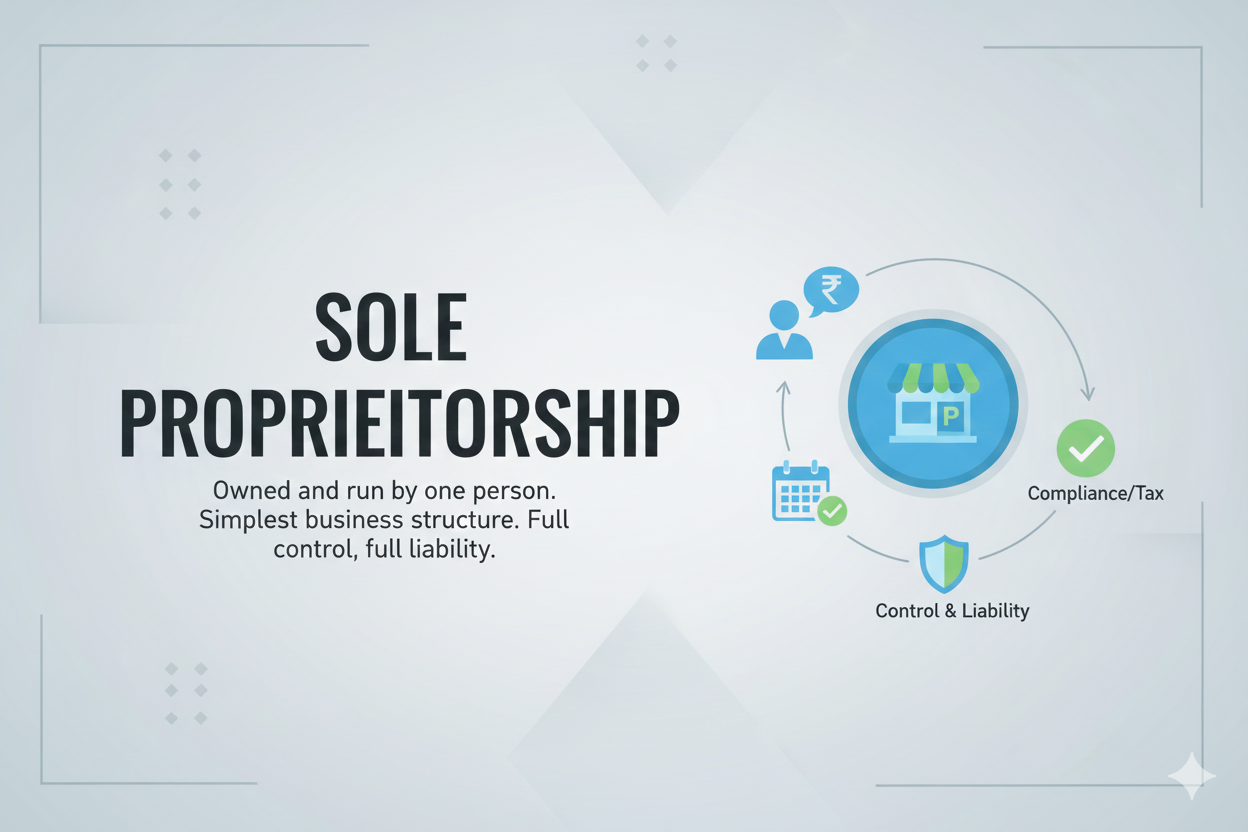
A sole proprietorship, also known as a sole tradership, individual entrepreneurship or proprietorship, is a type of enterprise owned and run by one person and in which there is no legal distinction between the owner and the business entity.
Proprietorship Identity & Mandatory Numbers
A Sole Proprietorship (or Sole Tradership) is owned and run by one person, where there is no legal distinction between the owner and the business entity. The compliances are therefore linked directly to the individual owner.
Essential Registrations:
- Permanent Account Number (PAN): Compulsory for all business transactions (the owner's personal PAN is used).
- Tax Deduction Account Number (TAN): Mandatory if the firm is required to deduct TDS.
Income Tax, Audit, and TDS Compliances
Income Tax Filing & Audit
- ITR Filing: Mandatory if the proprietor's income (business + other sources) exceeds the maximum amount not chargeable to tax.
- Tax Audit: Required if the firm's annual turnover is over Rs 100 Lakhs (or other prescribed limits under presumptive taxation).
TDS Obligations
- TDS Deduction: Required if the firm meets the threshold to deduct tax at source as per TDS rules.
- TDS Returns: If TDS is deducted, the firm must file quarterly TDS returns.
GST Registration and Return Filing
GST Applicability:
- Registration Threshold: GST registration is mandatory if the firm's annual turnover exceeds Rs40 Lakhs (or Rs20 Lakhs for North Eastern states and specified categories).
- GST Returns: After registration, firms must file monthly, quarterly, and annual GST returns (GSTR-1, GSTR-3B, GSTR-9) as per their opted scheme.
Choose Your Plan
Professional solutions tailored for Annual Compliance Proprietorship
Basic Plan
Every month payment option Available. Prices are inclusive of GST
- Turnover up to Rupees Two Crore
- GST filing including GST 9
- Income Tax filing of Proprietor
- Assistance & filing of tax audit report
- Book-Keeping and Accounting are not part of this package
Standard Plan
Every month payment option Available. Prices are inclusive of GST
- Turnover up to Rupees Five Crore
- GST filing including GST 9 and GST 9C
- Income Tax filing of Proprietor
- Assistance & filing of tax audit report
- Book-Keeping and Accounting are not part of this package
Premium Plan
Every month payment option Available. Prices are inclusive of GST
- Turnover up to Rupees Ten Crore
- GST filing including GST 9 and GST 9C
- Income Tax filing of Proprietor
- Assistance & filing of tax audit report
- Book-Keeping and Accounting are not part of this package
FAQ's on Annual Compliances For Proprietorship
Your Questions Answered
Which Income Tax Return (ITR) form is applicable for a Sole Proprietorship?
The income and expenses of the proprietorship are filed under the proprietor's individual PAN. The applicable forms are ITR-3 (if maintaining regular books of accounts) or ITR-4 (Sugam) (if opting for the Presumptive Taxation Scheme under Sec. 44AD/44ADA).
What is the default due date for ITR filing for a Sole Proprietor?
The standard due date for filing the Income Tax Return for a proprietor whose accounts are not required to be audited is typically July 31st of the subsequent assessment year.
When does a Tax Audit become mandatory for a Sole Proprietorship?
A Tax Audit (Form 3CB-3CD) is mandatory if the total annual turnover from business exceeds ₹1 Crore (or ₹10 Crore if cash receipts/payments are limited) OR if the gross receipts from a profession exceed ₹50 Lakh.
What is the ITR filing deadline if the proprietorship requires a Tax Audit?
If a Tax Audit under Section 44AB is mandatory, the due date for filing the Audit Report and the Income Tax Return (ITR-3) is extended to October 31st (the audit report itself must be submitted by September 30th) of the subsequent assessment year.
Is GST Registration and filing mandatory for every Sole Proprietorship?
No, GST registration is mandatory only if the annual aggregate turnover exceeds the threshold limit (currently ₹40 Lakh for goods and ₹20 Lakh for services in most states) or if the business engages in inter-state sales. If registered, monthly/quarterly returns (GSTR-1, GSTR-3B) and the annual return (GSTR-9) are mandatory.
Is a Sole Proprietor required to pay Advance Tax?
Yes. If the proprietor's total estimated tax liability for the year (after deducting TDS) exceeds ₹10,000, they are required to pay Advance Tax in four installments by the 15th of June, September, December, and March.
Does a Sole Proprietorship need to file an Annual Return with the ROC?
No. Unlike Private Companies or LLPs, a Sole Proprietorship is not registered with the Registrar of Companies (ROC) and is therefore exempt from filing statutory annual returns like Form AOC-4 or Form MGT-7.
What are the common non-tax annual compliances for a Proprietorship?
Key non-tax compliances include: 1) Renewal of the Shop and Establishment License (varies by state/local body). 2) Renewal of any Trade or Specific Licenses (e.g., FSSAI, Drug License). 3) Payment of Professional Tax (PT), if applicable in the state.