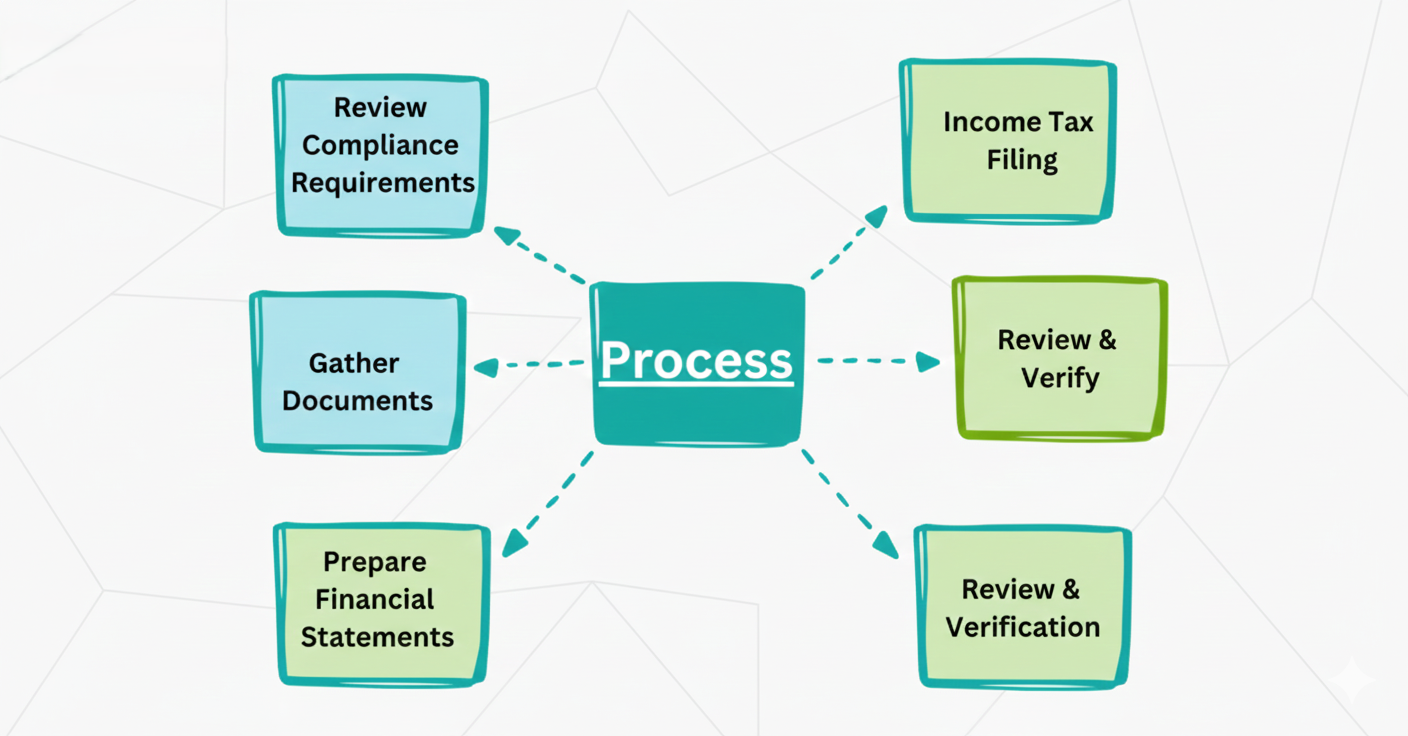
Annual Compliances for a Trust
Mandatory Legal and Financial Requirements for Tax-Exempt Status
Governance and Statutory Records
Trust Management Duties:
- Meetings: Conduct necessary Board Meetings (Governing Body) and General Meetings (Members) as stipulated in the Trust Deed.
- Minutes: Keep a comprehensive record of all Minutes of the Governing Body and Annual General Meetings.
- Fiduciary Duty: Ensure all activities strictly comply with the Trust Deed and that no funds are used for the personal benefit of Trustees or their family members.
Financial & Income Tax Compliances
Key Financial Requirements:
Accounting & Audit
- Books of Accounts: Mandatory maintenance as required by Income Tax provisions (Sec 12AB) and FCRA Act (if applicable).
- Annual Audit: Get books of accounts audited on an annual basis from a Chartered Accountant.
ITR & Deduction Filings
- ITR Filing: File the Income Tax Return (ITR-7) before the due date to avail benefits under Section 11 and 12 of the Income Tax Act (Exemption for Charitable/Religious purposes).
- TDS/80G: File TDS Returns and Donors' Returns (for donations received U/s 80G) before the due date.
- Certificate Issuance: Ensure issuance of 80G certificates to donors for their tax deduction claims.
Choose Your Plan
Professional solutions tailored for Annual Compliance Trust
Basic Plan
Prices are inclusive of GST
- Assistance & filing of audit report
- Filing of Income Tax Return (ITR)
- Book-Keeping and Accounting are not part of this package
Standard Plan
Prices are inclusive of GST
- Audit of Books of Accounts
- Filing of Income Tax Return (ITR)
- Book-keeping and accounting up to 400 entries annually
Premium Plan
Prices are inclusive of GST
- Audit of Books of Accounts
- Filing of Income Tax Return (ITR)
- Book-keeping and accounting up to 800 entries annually
- Filing of TDS returns and donors return from whom donations are received under Section 80G
- Maintenance of Books of Accounts as required by Section 12AB, 80G and FCRA Act
FAQ's on Annual Compliances For Trust
Your Questions Answered
Which ITR Form must a registered Trust file?
A Trust claiming exemption under Section 11 and 12, or registered under Section 12AB/10(23C), must mandatorily file its Income Tax Return using ITR-7. This is compulsory if the Trust's total income (before claiming exemptions) exceeds the basic exemption limit (₹2.5 Lakh).
What is the critical rule for a Trust to maintain its tax exemption?
The Trust must apply at least 85% of its income for charitable or religious purposes in India during the financial year. Failure to utilize this minimum percentage may lead to the income being taxed at the standard rates.
When is a Statutory Audit and Audit Report mandatory for a Trust?
A compulsory audit by a Chartered Accountant is required if the Trust's total income (before claiming exemptions under Sections 11 and 12) exceeds the maximum amount not chargeable to tax (₹2.5 Lakh). The audit report must be filed in Form 10B or Form 10BB.
What are the key due dates for filing ITR-7 and the Audit Report?
The audit report (Form 10B/10BB) must be filed electronically at least one month before the ITR due date (typically September 30th). The ITR-7 must be filed by October 31st of the subsequent assessment year (for audit cases).
Which form is mandatory for Trusts that accumulate income?
If a Trust is unable to apply the mandatory 85% of its income and wishes to accumulate the unspent portion for future specific projects, it must file Form 10 before the ITR due date. The accumulation period cannot exceed 5 years.
What is the compliance requirement for reporting donations?
Trusts registered under Section 80G must file Form 10BD (Statement of Donations) annually, reporting all donor details. They must also issue a certificate (Form 10BE) to the donors by May 31st to enable the donors to claim a tax deduction.
What is the primary consequence of failing to comply with these rules?
The most severe consequence is the potential loss of the Trust's tax-exempt status (registration under Section 12AB) for that particular financial year. This results in the entire income becoming taxable, often at the maximum marginal rate (MMR).
What is the compliance for Trusts receiving foreign contributions?
Trusts receiving foreign contributions must be registered under the FCRA (Foreign Contribution Regulation Act) and file an Annual Return in Form FC-4 with the Ministry of Home Affairs (MHA) by December 31st of the subsequent financial year, along with audited accounts.