Removal of
Existing Director
Statutory procedure under Companies Act, 2013 for removal and resignation of Directors in Private Limited Companies. Expert-assisted ROC compliance with end-to-end support.
Starting from Rs 2500/-
Complete resignation/removal with all ROC filings and documentation.
4-5 Days Timeline
Fast-track filing with dedicated CA/CS expert support throughout the process.
Simple & Secure
Complete online process with transparent pricing and data security.
Expert CA/CS Advice
Professional guidance on statutory notices, resolutions, and filings.
Why Client Filing India?
- Experienced & trusted professionals.
- Transparent & affordable pricing.
- On time support and timely services.
- Data security & confidentiality.
- Happy clients across all over India.
Removal Procedure (Section 169)
Complete step-by-step process for director removal through Ordinary Resolution
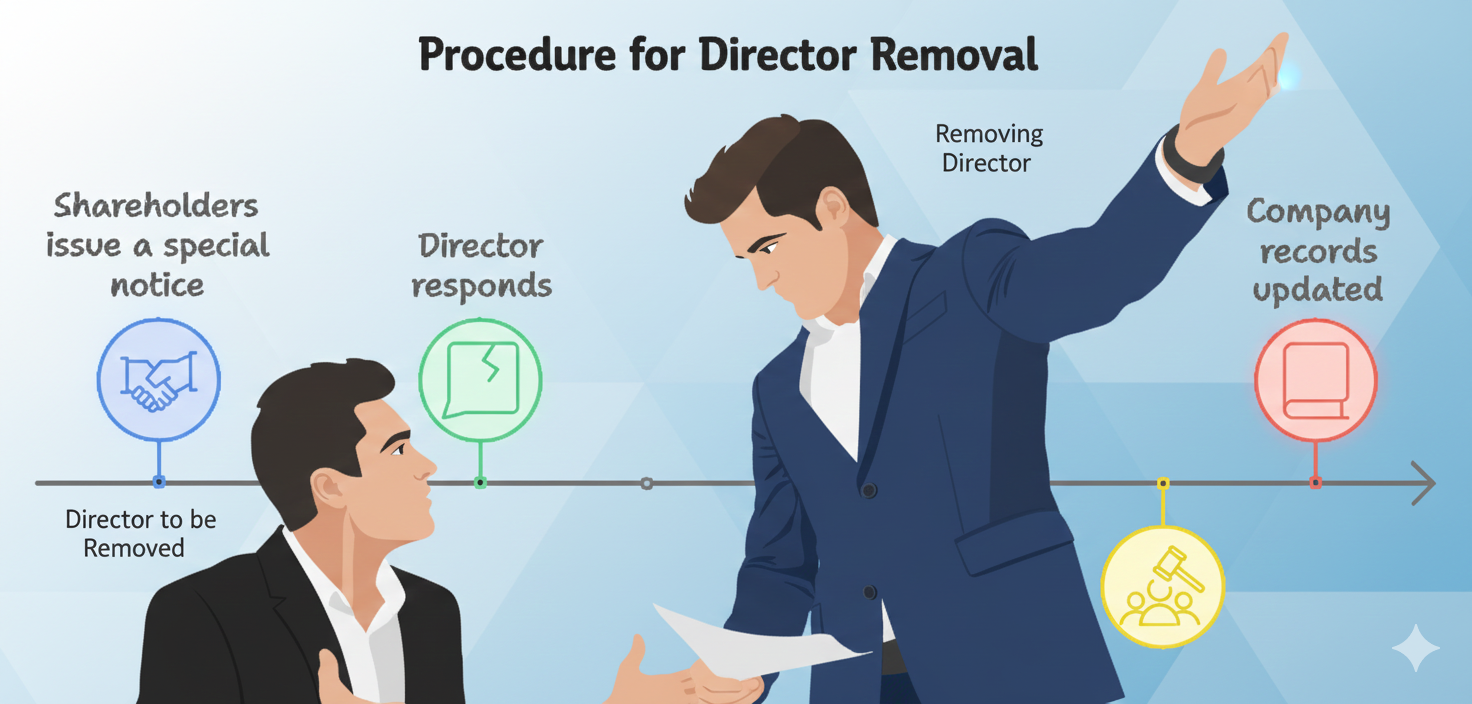
Initiation & Special Notice
Company can remove a Director by passing an Ordinary Resolution (unless appointed by Central Govt or Tribunal). A special notice is required for such removal.
- Notice must be given to the company by members
- Director entitled to attend meeting and be heard
Board Meeting Notice
Board Meeting called with 7 days' notice to all Directors. Special notice about proposed removal must be included.
- Notice served by mail or post to all directors
- Proof of dispatch must be retained
Board Resolution & EGM Call
Board passes resolution to hold Extraordinary General Meeting (EGM) and propose removal subject to shareholders' approval.
- EGM conducted with 21 days' clear notice to all members
- Notice includes resolution for removal
Right to Be Heard & Shareholders' Vote
Director gets reasonable opportunity to present explanation at the EGM. Members vote on the proposal.
- Director can attend and be heard on the resolution
- Removal passed if majority of members approve
ROC Filings (DIR-11 & DIR-12)
After passing the resolution, company must file Form DIR-12 with MCA. Director can also file DIR-11 on his behalf.
- Form DIR-12 filed with Board Resolution & Ordinary Resolution copies
- Filing within 30 days of passing resolution
- Director's name removed from MCA records
Resignation of Director (Section 168)
Director can resign voluntarily by giving written notice to the company.
- Written resignation notice to company (mail/post)
- Director files DIR-11 within 30 days
- Company passes Board resolution approving resignation
- Company files DIR-12 within 30 days
- Proof of dispatch of resignation must be retained
- Company acknowledges receipt of resignation
Director can file DIR-11 on his behalf to confirm resignation even if company doesn't cooperate.
Vacation of Office (Section 167)
Office of director becomes vacant automatically on occurrence of certain events:
- Disqualification under Section 164
- Absent from all Board meetings in 12 months
- Violation of Section 184 (interested contracts)
- Disqualified by court/Tribunal order
- Convicted & sentenced to imprisonment greater or equal 6 months
- Failure to disclose interest in contracts/arrangements
Company must file DIR-12 within 30 days of occurrence of event.
Appointment in Place of Removed Director
If the removed director was appointed by the company in general meeting or by the Board, the vacancy may be filled by appointing another Director at the same meeting where removal is passed, provided special notice of the proposed appointment has been given.
- New Director holds office until the date the removed director would have held
- If vacancy not filled, it may be filled as a casual vacancy
- The removed director cannot be re-appointed by the Board
Key Points to Consider
- Removal under Section 169 applies to all directors except those appointed by Central Govt or Tribunal
- Special notice required for removal resolution
- Director has right to be heard before removal
- All ROC forms must be filed within prescribed time limits
- For NRI/Foreign National directors, documents must be notarized
Documents Required
-
Copy of Board Resolution / Special Resolution
-
Relieving Letter / Resignation Letter
-
Acknowledgement of Resignation by Company
-
Proof of Dispatch of Resignation Letter
-
DSC of Director
-
For NRI / Foreign National: documents must be notarized
Quick Consultation
Get expert advice in 2 hours
Choose Your Plan
Professional solutions tailored for Removal Of New Director
Basic Plan
Prices are inclusive of GST
- Removal of Director.
- Dsc charges are not included in package.
Standard Plan
Prices are inclusive of GST
- Removal of Director.
- Dsc charges are not included in package.
Premium Plan
Prices are inclusive of GST
- Removal of Director.
- Dsc charges are included in package.
FAQ's on Removal Of Existing Director
Your Questions Answered
What is the main legal provision for the removal of a Director?
A company can remove a Director before the expiry of their term by passing an Ordinary Resolution at a General Meeting of the shareholders, as per Section 169 of the Companies Act, 2013. This power primarily rests with the shareholders, not the Board.
What is the prerequisite notice required for initiating the removal process?
The shareholders proposing the removal must give a Special Notice (Section 115) to the company at least 14 days before the General Meeting. The company then forwards this notice to the Director proposed for removal.
What is the Director's fundamental right before removal?
The Director proposed for removal has the statutory right to a reasonable opportunity of being heard (Right of Representation). This includes the right to make a written representation to the company and speak at the General Meeting where the resolution is moved.
Can a Director appointed by Proportional Representation be removed under Section 169?
No. The provision for removal by ordinary resolution under Section 169 does not apply to Directors appointed by the method of Proportional Representation (Section 163) or those appointed by the National Company Law Tribunal (NCLT).
Which mandatory e-form must the company file with the ROC after removal?
The company must file e-Form DIR-12 (Particulars of Appointment/Cessation of Director) with the Registrar of Companies (ROC) within 30 days from the date the Ordinary Resolution was passed in the General Meeting.
What happens if the Director resigns instead of being removed?
If the Director voluntarily resigns, the company must file Form DIR-12 to report the cessation. Additionally, the resigning Director has the option to file e-Form DIR-11 to personally inform the ROC of their resignation.
What is the penalty for failing to file Form DIR-12 within the stipulated time?
Failure to file DIR-12 within the 30-day timeline attracts substantial late fees (additional fees) calculated progressively based on the period of delay. Prolonged non-compliance can result in the company being marked as non-compliant.
Can the removed Director claim compensation?
Yes. Section 169 does not deprive the removed Director of any right to claim compensation or damages that may be payable to them as per the terms of their contract or service agreement with the company.